Big Theta Notation
The big theta notation is used to describe the asymptotic efficiency of algorithms.
It is written Θ(f(n)) where n∈N (sometimes sets other than the set of natural numbers, N, are used).
The expression Θ(f(n)) is the set of functions
{g(n):∃c1,c2,n0∈N, ∀n≥n0, 0≤c1f(n)≤g(n)≤c2f(n)}.
In plain English, this set is populated by functions that are sandwiched by c1f(n) and c2f(n).
This is known as a tight asymptotic bound.
For set membership, we write h(n)=Θ(f(n)) and not h(n)∈Θ(f(n)).
Examples
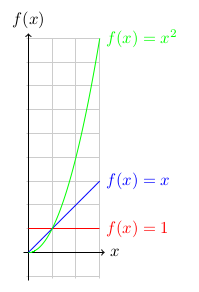
A list of expressions and their big theta bounds are given below, and below this list is a graph showing the growth of some functions.
2=Θ(1)4x+2=Θ(x)3x2+4x+2=Θ(x2)
References
T. H. Cormen, C. E. Leiserson, R. L. Rivest, Introduction to Algorithms. MIT Press, 1990.